
TOKYO (R2E) — According to early results, the ruling party of Japanese Prime Minister Sanae Takaichi won a two-thirds supermajority in parliamentary elections, according to Japanese media. The overwhelming win, which was largely attributed to the first female prime minister of Japan’s tremendous popularity, enables her to implement a substantial conservative change in immigration, security, and other areas of Japanese policy.
After winning, Takaichi stated in a broadcast interview with the public television network NHK that she would prioritize measures aimed at making Japan powerful and affluent.
Takaichi’s Liberal Democratic Party, or LDP, alone won 316 seats by early Monday, easily surpassing a 261-seat absolute majority in the 465-member lower house, the more powerful of Japan’s two-chamber parliament, according to NHK, which cited vote count figures. That beats the previous high of 300 seats gained by the late Prime Minister Yasuhiro Nakasone in 1986 and sets a new record since the party’s founding in 1955.
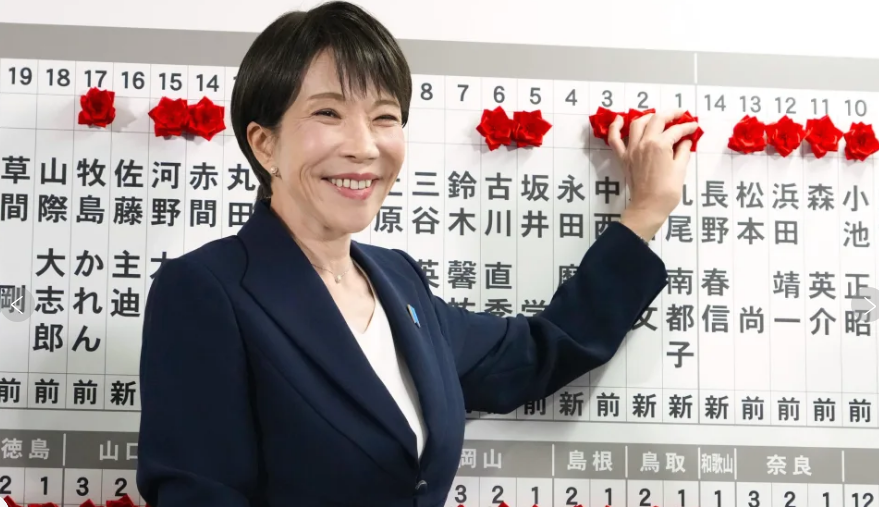
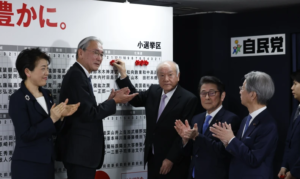
While accompanying party executives cheered, a grinning Takaichi affixed a large red ribbon above each winner’s name on a signboard at the LDP headquarters.
Although there isn’t a majority in the upper house, Takaichi would be able to advance her right-wing agenda, which aims to strengthen Japan’s economy and military capabilities as tensions with China increase and she attempts to strengthen ties with the United States, thanks to the significant increase in the preelection share in the superior lower house.
Takaichi stated that she will adamantly pursue her policy objectives while attempting to win over the opposition.
“I’ll be adaptable,” she declared.
Despite Takaichi’s popularity, the LDP, which has controlled Japan for the majority of the previous 70 years, has recently faced financial difficulties and religious controversies. After just three months in office, she called Sunday’s early election in an attempt to reverse that while she is still quite popular.
Popular leader
The ultraconservative Takaichi, who became Japan’s first female leader in October, promised to “work, work, work.” Her tough yet amusing manner has won over younger supporters who claim they had no prior interest in politics.
The opposition was too fragmented to pose a serious threat, even with the emergence of a new centrist alliance and a growing far-right. It is predicted that the liberal-leaning Constitutional Democratic Party of Japan and Buddhist-backed dovish Komeito, the LDP’s previous coalition partner, will lose half of their preelection share of 167 seats in the new opposition alliance.
With this election, Takaichi was placing a wager that her LDP party and its new ally, the JIP, would win a majority.
On Sunday, Trump congratulated Takaichi “on a LANDSLIDE Victory in today’s very important Vote” in a post on his Truth Social platform. She is a well-liked and respected leader. Sanae’s audacious and sensible move to call for an election was quite successful.
53-year-old office worker Akihito Iwatake said he was happy with the LDP’s significant victory since he believed the party had become too liberal in recent years. “I believe that Takaichi’s shift toward conservatism produced this favorable outcome,” he stated.
Takaichi’s policies
According to JIP leader Hirofumi Yoshimura, the LDP’s right-wing ally, Takaichi’s campaign for conservative measures will be “accelerated” by his party.
Far-right populists, including the anti-globalist and burgeoning nationalist group Sanseito, have gained traction in Japan recently. Exit polls predicted Sanseito would make a significant gain.
When the lower house reconvenes in mid-February, Takaichi’s first significant assignment will be to work on a budget bill that was postponed due to the election in order to finance economic policies to address stagnant salaries and growing costs.
With the relaxation of a prohibition on weapons exports and a shift away from Japan’s postwar pacifist ideals, Takaichi has promised to update security and defense plans by December in order to strengthen Japan’s offensive military capabilities.
She has been advocating for anti-espionage, stricter foreign policy, and other ideas that appeal to the far right but that experts warn could jeopardize civil rights.
In response to calls from U.S. President Donald Trump for Japan to loosen its purse strings, Takaichi also wants to increase defense spending.
Now that there won’t be an election until 2028, she has time to work on these ideas.
Divisive policies
Takaichi mainly avoided talking about how to pay for skyrocketing military spending, how to resolve diplomatic conflict with China, and other concerns, even though she stated that she is trying to gain support for policies that are viewed as divisive in Japan.
Given their shared concerns about North Korean and Chinese threats, Takaichi is expected to keep cordial ties with South Korea despite her rightward turn. However, given Japan’s history of war, Seoul would be concerned about any attempt by the country to amend its pacifist constitution or strengthen its military, according to Leif-Eric Easley, a professor of international studies at Ewha Womans University in Seoul.
Takaichi spoke passionately during her campaign speeches about the necessity of government expenditure to finance “crisis management investment and growth,” including initiatives to improve technology, economic security, and other sectors. Takaichi also wants to promote more stringent immigration laws, such as a cap on foreign residents and more stringent standards for foreign property owners.
Masato Kamikubo, a professor of politics at Ritsumeikan University, stated that Sunday’s election “underscores a problematic trend in Japanese politics in which political survival takes priority over substantive policy outcomes.” “The next election always looms whenever the government tries necessary but unpopular reforms.”
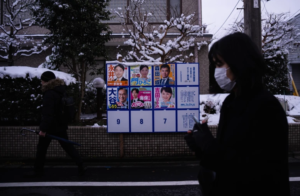
On Sunday, February 8, 2026, a pedestrian walks past an election board in Tokyo that has posters of candidates for the lower house election.