
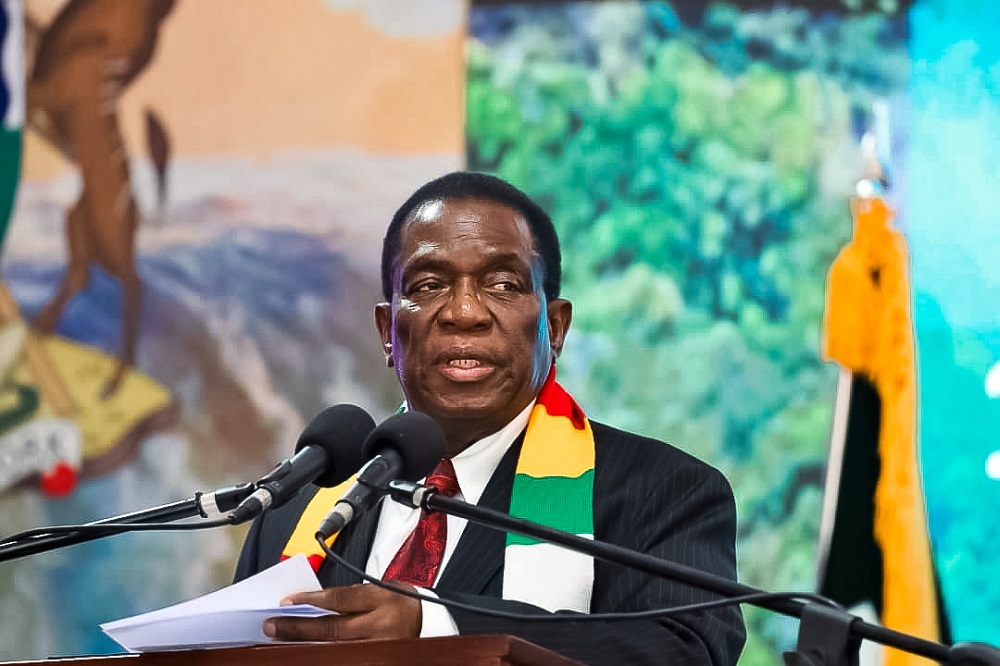
Draft constitutional revisions that could extend President Emmerson Mnangagwa’s term in office until at least 2030 have been accepted by Zimbabwe’s cabinet.
The Constitutional Amendment No. 3 Bill of 2026 aims to increase the duration of both the presidential and legislative mandates from five to seven years. It also suggests a parliamentary method for choosing the president.
According to the Bill, the President of Zimbabwe would be chosen by members of Parliament who serve as both the National Assembly and the Senate. Under the current constitutional structure, the President of Zimbabwe is directly elected by millions of citizens.
In addition to controlling the upper house of Parliament through traditional leaders and other presidential appointees, ZANU-PF currently holds a two-thirds majority in the lower house, giving it the ability to amend the constitution.
Speaking to reporters at a post-Cabinet briefing held by Zimbabwean Information, Publicity and Broadcasting Services in Harare on Tuesday, Minister Jenfan Muswere stated that the Bill’s main goals are to improve political stability and policy continuity so that development programs can be carried out through to their conclusion.
However, a number of opposition leaders and analysts have insisted that a national referendum would also be required for any constitutional amendment.
According to Minister Muswere, the Bill specifically includes the following: Clause 1 specifies the Bill’s title. Section 92 of the Constitution is repealed in Clause 2 and replaced with a legislative system for choosing the president. According to the document, a run-off election will be place if no candidate receives an absolute majority of the vote.
The Chief Justice or a chosen judge supervises the procedure to make sure it is carried out correctly. By encouraging equity, transparency, and judicial supervision in the electoral process, these actions enhance constitutional accountability.
“The election process will follow the standing rules and orders of Parliament,” Muswere continues. Clauses 3.7 and 8 change Sections 95, 143, and 158 of the Constitution to provide the President and Parliament seven-year terms instead of the present five-year ones. This reform aims to improve policy continuity, lessen election-related interruptions, provide long-term national initiatives more time to be implemented, and advance political and economic stability.
Since Zimbabwe gained independence from the United Kingdom in 1980, ZANU-PF has been in power.
It can alter the constitution since it has a two-thirds majority in the lower house of parliament and a strong hold on the upper house through traditional leaders and other proxies who often vote with it.
Any constitutional amendments, according to analysts and opposition leaders, would also require a nationwide referendum.
“A referendum should be held on any amendment that has the ‘effect’ of prolonging the tenure of an incumbent,” opposition member David Coltart stated. “They will do everything in their power to prevent a referendum because they know that if that occurs, they will fail.”
Mnangagwa, who was elected in 2018 and re-elected in 2023, has been under fire for allegedly permitting widespread corruption and repressing human rights while Zimbabweans suffer in spite of the country’s expanding economy.
Over the past few months, attempts to protest the plot to keep him in office have been met with a police crackdown that has resulted in numerous arrests.