
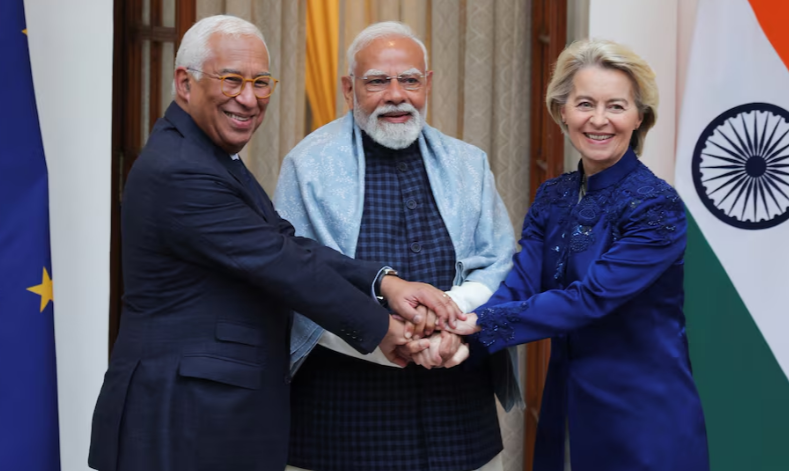
In an effort to increase two-way commerce and lessen dependency on the United States amid escalating global trade tensions, India and the European Union reached a long-delayed agreement on Tuesday that will lower tariffs on the majority of goods.
By removing or lowering tariffs on 96.6% of traded items by value, the agreement is anticipated to increase EU exports to India by 2032 and save European businesses 4 billion euros ($4.75 billion) in charges, according to the EU.
According to a statement from India’s commerce ministry, the EU would reduce tariffs on 99.5% of items imported from India over a period of seven years. Tariffs on Indian maritime goods, leather and textile products, chemicals, rubber, base metals, gems, and jewelry will be eliminated.
Agriculture-related products like soy, beef, sugar, rice, and dairy have been excluded from the trade pact, according to India and the EU. “Yesterday, a big agreement was signed between the European Union and India,” Indian Prime Minister Narendra Modi stated earlier.This is being referred to as the mother of all deals by people all across the world. The 1.4 billion people in India and the millions of people in Europe would benefit greatly from this deal, he said.
After Washington put a 50% tariff on select Indian imports and U.S. allies retaliated against President Donald Trump’s tariff threats and his desire to annex Greenland, the two-decade-long EU-India trade negotiations gathered steam.
In a speech that received a standing ovation in Davos last week, Canadian Prime Minister Mark Carney called on middle powers to unite in order to prevent becoming victims. After just reaching an agreement with China, he intends to travel to India to finalize agreements on uranium, energy, and minerals.
Following agreements with Indonesia, Mexico, and Switzerland last year, the EU reached an agreement with the South American body Mercosur before to signing the agreement with New Delhi. New Delhi completed agreements with Oman, New Zealand, and Britain at that time.
“Europe and India are making history today,” stated Ursula von der Leyen, president of the European Commission. “This is only the beginning.”
In the fiscal year ending in March 2025, commerce between India and the EU was $136.5 billion, while trade between India and the United States was $132 billion, and trade between India and China was $128 billion.
According to an Indian government official with knowledge of the situation, the formal signing of the India-EU agreement would occur following legal screening, which is anticipated to take five to six months.
The insider went on, “We expect the deal to be implemented within a year.”
As with Mercosur, there may be certain obstacles in the EU region’s screening procedure. The EU-Mercosur pact will be challenged at the bloc’s highest court, according to a vote by EU parliamentarians.
OPENING UP GUARDED SECTORS
European manufacturers including Volkswagen, Renault, Mercedes-Benz, and BMW would profit from the EU agreement with India, which would open up the country’s sizable and fiercely guarded market. According to an EU statement, New Delhi will reduce automobile tariffs to 10% over five years from as high as 110%.
According to both parties, the lower auto tariffs would be applied to 250,000 vehicles annually worth more than 15,000 euros and would be reduced to 30%–35% as soon as the agreement is put into effect.
India is also slashing tariffs on alcoholic beverages like wines to 75% immediately from 150%, which would be lowered to 20% gradually. Tariffs on spirits will be lowered to 40%, the EU said.
According to the EU, the agreement will also lower tariffs on a variety of EU products entering India, including iron and steel, machinery, electrical equipment, and chemicals.
However, Indian businesses affected by the carbon tax under the EU’s Carbon Border Adjustment Mechanism (CBAM), which went into effect on January 1, did not receive any immediate assistance.
In addition to steel, cement, power, fertilizers, and other goods are also subject to the decarbonization-oriented charge.
According to India, the EU has promised to provide it carbon tax flexibilities if any foreign nations receive them.
In addition, the EU decided to give India 500 million euros in funding over the following two years to assist it in reducing its emissions of greenhouse gases.
$1 is equivalent to 0.8422 euros.