

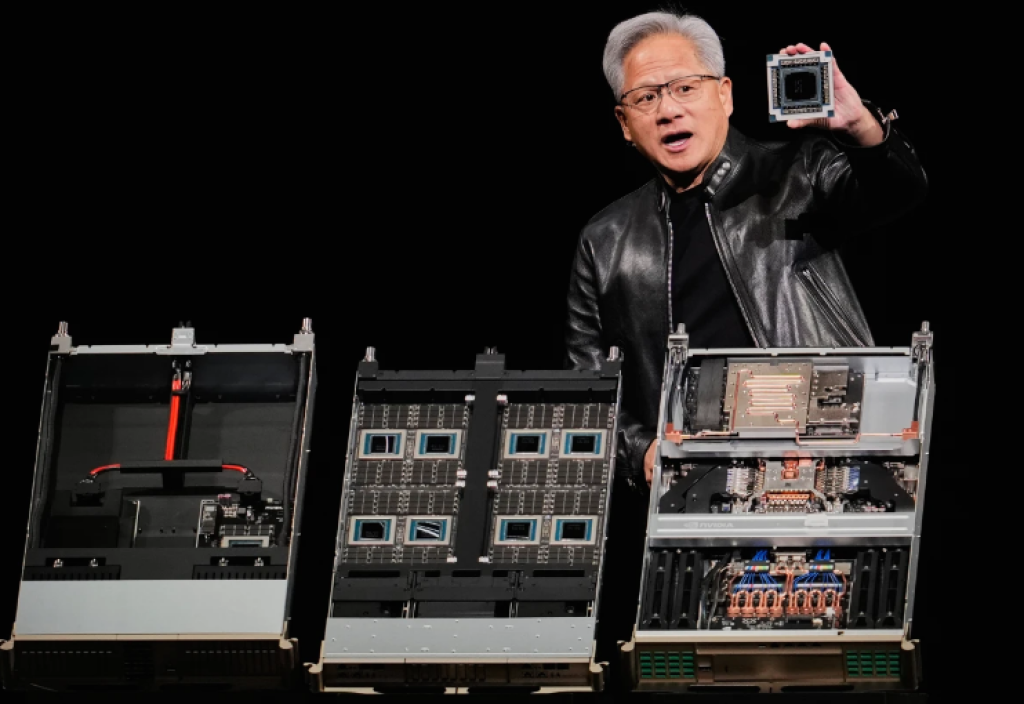
On Monday, Jensen Huang, CEO of Nvidia, expounded on his strategy for maintaining his company's leadership in the artificial intelligence boom, which he projected will result in a $1 trillion backlog of orders within the next year.
Wearing his trademark black leather jacket, Huang wandered across a stage in a crowded arena in San Jose, California, for over two hours, describing how Nvidia's processors became essential AI components and showcasing the products that he thinks will keep the company at the top.
The 63-year-old Huang also discussed a number of topics he has been promoting since becoming one of Silicon Valley's most prominent voices in recent years, such as his claim that the development of AI is still in its early stages.
The shift focuses on inference processors, which effectively execute educated AI models following the first training stage, enabling real-time applications like chatbots, robots, and enterprise automation. Nvidia won a multi-billion dollar licensing agreement with Groq, which included the purchase of key engineers, and introduced the Vera Rubin platform, which combines next-generation Rubin GPUs with an 88-core Vera CPU, to bolster its position.
Nvidia's stock barely gained 1.2% to 2% after the release, despite the bright outlook, indicating investor caution amid extremely high expectations. Although the $1 trillion ambition is credible, analysts point out that whether or not it becomes the long-awaited economic stimulus will depend on execution and hyperscaler spending in 2026–2027.
Huang declared, "We reinvented computing, just like the PC (personal computer) revolution and the internet revolution." "A new platform change is about to begin."
Huang doubled his prediction from a year ago to emphasize his arguments, predicting that Nvidia will be struggling with a $1 trillion backlog in orders for its processors by the end of the year.
Nvidia has increased its yearly sales from $27 billion in 2022 to $216 billion last year by leveraging its leading position in the AI chip market. This growth rate has resulted in a $4.5 trillion market valuation for the Santa Clara, California-based business.
However, since the business temporarily became the first to achieve a $5 trillion market valuation last October due to concerns that the AI boom is exaggerated, Nvidia's once-torrid stock has cooled.
Nvidia is facing its first significant obstacles in the AI chip industry as rival tech giants like Google and Facebook's corporate parent Meta Platforms attempt to develop their own processors, despite analysts predicting that the company's sales would exceed $330 billion in the coming year.
Security and trade restrictions imposed by the United States are impeding Nvidia's potential growth by making it difficult for the business to sell its cutting-edge chips in China.
Huang sees Nvidia continuing to meet the intense demand for chips that drive chatbots like Google's Gemini and OpenAI's ChatGPT, as well as growing its presence in the developing inference processor market, in order to continue its crucial role in AI.
After an AI tool has been trained, inference chips allow it to use what it has learned to make responses, such as writing a paper or drawing an image, more effectively than the processors used during the development of the massive language models.
Huang declared, "The inference inflection has arrived."
Nvidia signed a multibillion-dollar licensing agreement with market leader Groq, which included hiring the company's top engineers, to assist guide its entry into the inference space.
Ives stated, "Nvidia isn't going to give up any market share to Google or Meta." He predicts that Nvidia's market valuation will surpass $6 trillion in the coming year.