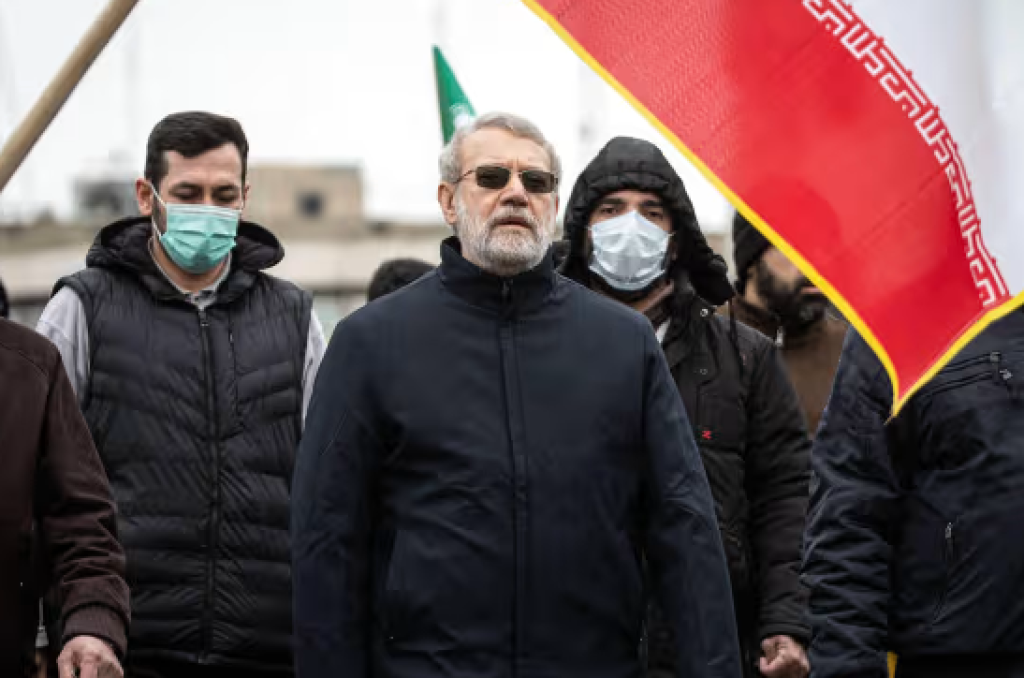
Iran's Supreme National Security Council released a statement confirming the death of its secretary, Ali Larijani, following an Israeli bombing. During an overnight strike, he was slain along with his son Morteza Larijani, Alireza Bayat, the chief of his office, and a number of guards.
Israel called the deaths of Larijani and Gen. Gholam Reza Soleimani, the commander of the Revolutionary Guard's Basij division, a significant setback for Iran's leadership. After Supreme Leader Ayatollah Ali Khamenei was killed in the initial U.S. and Israeli bombings that started the war, Larijani became one of Iran's most prominent politicians.
After the country's supreme leader was killed in U.S. and Israeli bombings late last month, which launched an expanding war, Larijani was widely thought to be in charge. Iran didn't acknowledge Larijani's death for several hours after Israel claimed to have murdered him earlier on Tuesday.
Just two weeks before the war started, he traveled to Oman to meet with mediators after being chosen to advise Supreme Leader Ayatollah Ali Khamenei on strategy in nuclear talks with the Trump administration. Larijani was subject to severe U.S. sanctions and was linked to the brutal suppression of large-scale protests in January, just like other prominent Iranian figures.
Since he is not a Shiite cleric, he was not qualified to succeed Khamenei as supreme leader. However, many thought he was in charge of the nation because Iran's leadership has gone underground due to Israeli and American strikes, and he was generally expected to function as a top adviser. His son Morteza Larijani was also slain, according to the Supreme National Security Council.
Larijani reacted on X a week ago to U.S. President Donald Trump's vow to attack Iran "TWENTY TIMES HARDER" if Tehran stopped sending oil over the Strait of Hormuz.
Iran is a selfless nation that is not afraid of your baseless threats. He wrote, "Even those larger than you couldn't destroy Iran." "Take care not to be eliminated yourself."
Larijani was born into one of Iran's most well-known political families, which numerous media outlets have likened to the American Kennedys. One brother, Sadeq, headed Iran's judiciary, and another, Mohammad Javad, was a top diplomat who provided the late Khamenei with close foreign policy advice.
In August 2025, President Masoud Pezeshkian named him as the SNSC's secretary and as the late Ayatollah Ali Khamenei's representative.
Iranian media outlets have often referred to him as the late supreme leader's advisor. From May 2008 to May 2020, he presided over the Iranian parliament for twelve years.
In recent years, he has been referred to as a "moderate conservative" despite leading the Principlist faction in parliament from 2008 to 2012.
Larijani was Iran's top nuclear negotiator from 2005 to 2007 before he was elected speaker.
Larijani's threats became more severe with time. He tightened censorship while serving as Iran's cultural minister in the 1990s. In addition to leading the Supreme National Security Council most recently, he was the speaker of parliament from 2008 to 2020.
He authored at least six volumes on philosophy, three of which examined the writings of Immanuel Kant, a German philosopher.