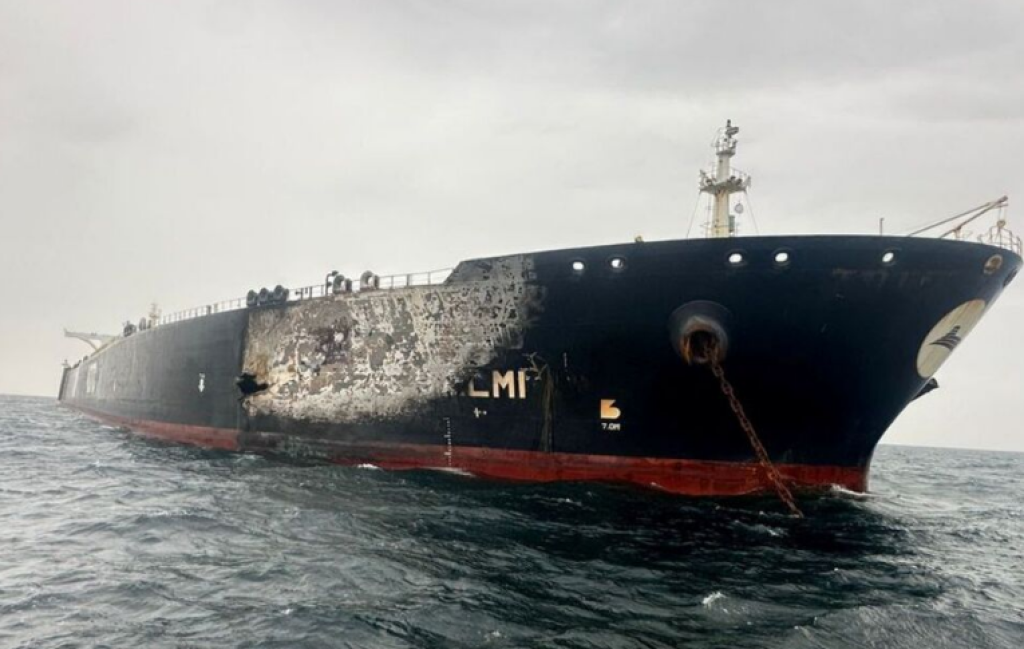
Tensions in the Gulf escalated Tuesday after a Kuwaiti‑flagged oil tanker was struck by an Iranian drone near Dubai, igniting a fire on board. The attack came despite President Donald Trump’s warning that the United States would destroy Iran’s energy facilities if Tehran refused to reach a peace agreement and reopen the Strait of Hormuz.
The Incident
Dubai authorities confirmed that the blaze aboard the Al‑Salmi was contained without casualties or oil spillage. Kuwait Petroleum Corp., the vessel’s owner, reported hull damage but said all 24 crew members were safe. The tanker was carrying nearly two million barrels of crude oil from Kuwait and Saudi Arabia, valued at more than $200 million at current prices.
Tracking data from TankerTrackers.com indicated the ship was en route to Qingdao, China. Iran’s Revolutionary Guard initially claimed responsibility for striking a container ship linked to Israel, but shipping records suggested the intended target may have been the Singapore‑flagged Haiphong Express, anchored nearby.
Market Reaction
News of the attack briefly sent crude prices higher before easing after reports that Trump was considering diplomatic options over military escalation. Brent crude has already surged 59% in March, the largest monthly increase on record, while U.S. households face rising fuel costs. Analysts warn that continued disruption in the Strait of Hormuz — which carries one‑fifth of global oil and gas supplies — could trigger further volatility.
U.S. Response and Military Moves
The White House press secretary said Trump extended his deadline for Iran to reopen the strait until April 6, while signaling negotiations with what he called a “more reasonable regime.” Thousands of soldiers from the U.S. Army’s 82nd Airborne Division have begun arriving in the Middle East, reinforcing American options as talks continue.
Regional Escalation
The conflict has widened beyond Iran. Houthis in Yemen fired into Israel, Turkey reported intercepting an Iranian missile that entered its airspace, and Hezbollah intensified attacks on Israeli positions. Iran claimed responsibility for strikes on U.S. bases in Gulf states and Israel, while Saudi Arabia reported debris damage from intercepted drones.
Inside Iran, explosions were reported in Tehran’s Pirouzi district, causing power outages. In Zanjan, three people were killed in an attack on a Shi’ite assembly hall. Meanwhile, Israel confirmed the deaths of four soldiers and three Indonesian UN peacekeepers in southern Lebanon.
Political and Economic Fallout
The tanker strike underscores the growing risks to global energy markets and the political challenges for Trump ahead of U.S. midterm elections. Rising oil prices have already strained household budgets, complicating his pledge to reduce energy costs and expand domestic production.
The attack on the Al‑Salmi highlights the vulnerability of Gulf shipping lanes and the escalating confrontation between Iran, the U.S., and regional powers. With oil markets rattled and military deployments increasing, the Strait of Hormuz remains the flashpoint of a conflict that shows no signs of abating.