
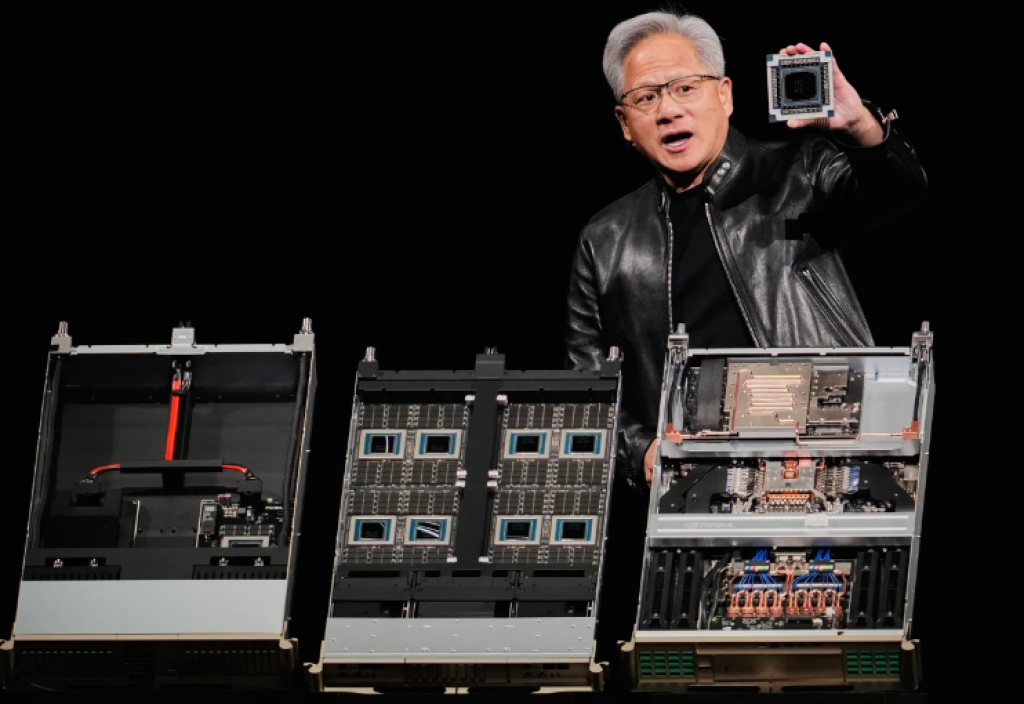
On Monday, Nvidia CEO Jensen Huang delivered a two‑hour keynote in San Jose, California, laying out his vision for the company’s future in artificial intelligence. Wearing his trademark black leather jacket, Huang projected a $1 trillion backlog of orders within the next year, underscoring Nvidia’s dominance in the AI chip market and its ambitions to stay ahead of rivals.
Table of contents [Show]
Nvidia’s Rise in the AI Era
- Revenue Growth: Nvidia’s annual sales surged from $27 billion in 2022 to $216 billion in 2025.
- Market Valuation: The company briefly hit $5 trillion in October 2025 before cooling, now valued at $4.5 trillion.
- AI Leadership: Nvidia’s GPUs are the backbone of AI training, powering models like OpenAI’s ChatGPT and Google’s Gemini.
Huang compared Nvidia’s role to past technological revolutions:
“We reinvented computing, just like the PC revolution and the internet revolution. A new platform change is about to begin.”
The Shift to Inference
Huang emphasized that the next frontier is inference processors — chips that allow trained AI models to generate real‑time outputs.
- Applications: Chatbots, robotics, enterprise automation, and creative tools.
- New Platform: The Vera Rubin system combines next‑generation Rubin GPUs with an 88‑core Vera CPU.
- Strategic Deal: Nvidia signed a multi‑billion dollar licensing agreement with Groq, acquiring key engineers to strengthen its inference capabilities.
This shift marks a new phase in AI adoption, expanding applications beyond training into everyday use cases.
Investor Reaction
Despite Huang’s bold predictions, Nvidia’s stock rose only 1.2%–2% after the event. Analysts caution that execution and hyperscaler spending in 2026–2027 will determine whether the $1 trillion backlog materializes.
Competitive Landscape
Nvidia faces growing challenges:
- Google & Meta: Developing in‑house processors to reduce reliance on Nvidia.
- U.S. Trade Restrictions: Limiting sales of advanced chips to China, a major market.
- Investor Skepticism: Concerns about whether the AI boom is sustainable.
Broader Implications
- Economic Impact: If realized, Nvidia’s $1 trillion backlog could act as a stimulus for the tech sector, driving investment in cloud infrastructure, robotics, and automation.
- Geopolitical Stakes: U.S. export controls highlight the strategic importance of AI chips in global competition.
- Innovation Cycle: The shift from training to inference marks a new phase in AI adoption, potentially expanding applications across industries.
Historical Context
Nvidia’s trajectory mirrors past tech giants:
- Intel in the PC era.
- Cisco during the internet boom.
- Apple during the smartphone revolution.
Huang positions Nvidia as the defining company of the AI age.
Expert Commentary
Analysts like Dan Ives predict Nvidia’s valuation could surpass $6 trillion in 2026, arguing the company will not cede market share to rivals. Others warn that over‑reliance on hyperscaler demand could expose Nvidia to volatility.
Jensen Huang’s keynote reinforced Nvidia’s central role in the AI revolution. With bold predictions, new platforms, and strategic deals, the company aims to maintain its dominance even as rivals emerge and geopolitical challenges mount. Whether Nvidia achieves its $1 trillion backlog will depend on execution, global demand, and the resilience of the AI boom.