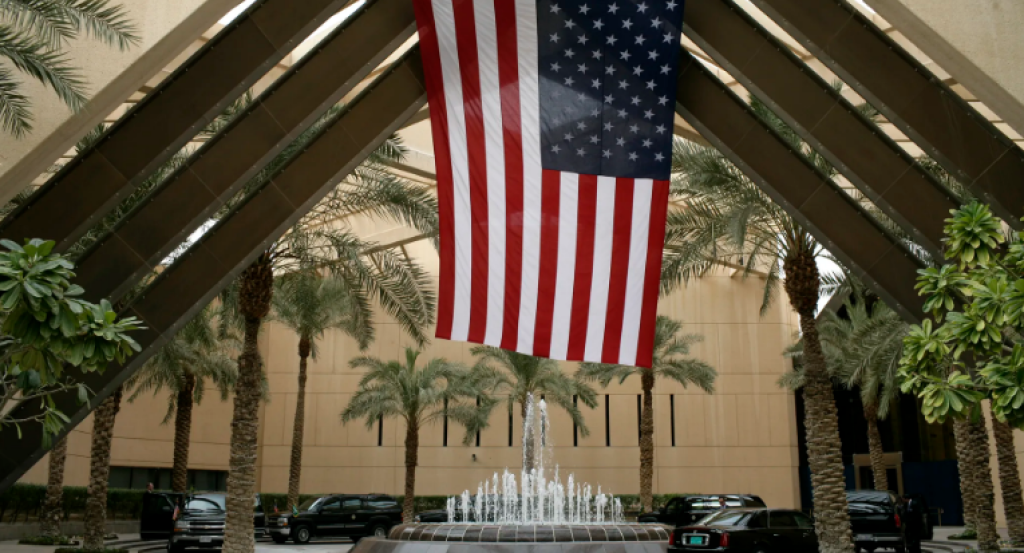
While Israel destroys Tehran and dispatches troops into southern Lebanon, Iranian drones strike the US embassy in Riyadh.
The kingdom's defense ministry stated in a post on X on Tuesday that two drones struck the U.S. embassy in Riyadh, causing a small fire and some material damage, citing an initial assessment.
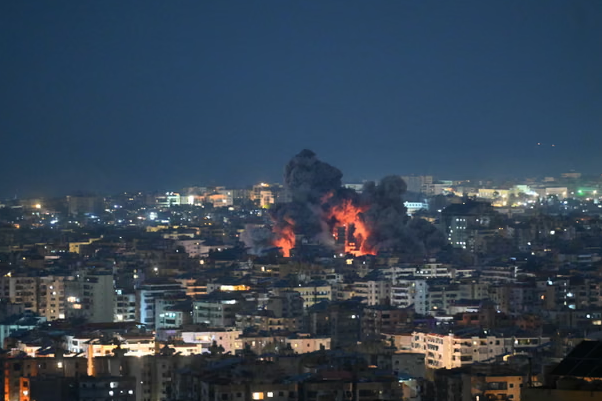
The pro-Iranian militia persisted in its attacks on Israel, claiming to have blasted a military camp on Tuesday morning and fired two missile salvos against military bases in northern Israel overnight. Israel virtually destroyed the land south of the Litani River and turned the southern suburbs of Beirut into a ghost town by carrying out strikes and ordering the evacuation of towns in southern Lebanon.
In response to additional Israeli-US bombings, Iran continued to bombard Israel and the Gulf on Tuesday, as Donald Trump declared that it was too late to engage in negotiations with Tehran.
"They have lost their leadership, Air Force, Navy, and air defense." They wish to converse. On his Truth Social platform, the US president said, "I said 'Too Late,'" denouncing what he alleged was an attempt by Tehran to resume talks. He declared that the United States was ready "to go far longer" than a four- to five-week conflict with Iran.
Trump's remarks were made just hours after Iranian drones struck the US embassy in Riyadh, starting a small fire and leading the diplomatic mission to advise Americans to leave the premises. Iran continued to target US bases, facilities, and troops in Arab Gulf states, and the attack came after a strike on the US embassy in Kuwait.
Israel ordered Iranians living near an airport in Karaj to evacuate as it threatened to launch a "extensive" wave of airstrikes in Tehran.
Hundreds of people were slain throughout the Middle East as the conflict spread, with Iran accounting for the great majority of those deaths.
The possibility of US troops on the ground in Iran was also openly discussed by US authorities, notably Pete Hegseth, the defense secretary. Analysts opposed this idea, citing Iran's large, hilly terrain as a barrier to any force presence.
The "hardest hits are yet to come," according to Secretary of State Marco Rubio, while administration officials reported that their strategy for the Iran campaign had so far gone more smoothly than anticipated.
Trump, for his part, has alternately stated that he was only attempting to stop Iran from developing a nuclear weapon and to stop its ballistic missile program, while at other times he has stated that the objective was regime change in Iran. Iran has continuously denied that it is working on nuclear weapons.
Trump, for his part, has alternately stated that he was only attempting to stop Iran from developing a nuclear weapon and to stop its ballistic missile program, while at other times he has stated that the objective was regime change in Iran. Iran has continuously denied that it is working on nuclear weapons.
As the US-Israeli campaign progressed, explosions were heard throughout Iran during the night, especially in the capital. Between 787 and 1,500 individuals are thought to have died in the strikes, including 165 in a strike on a southern Iranian girls' primary school.
Iran kept launching ballistic missile bursts at Israel, the most of which were intercepted. Eleven Israelis were killed when a few missiles managed to get past the nation's advanced missile defense system.
Three Iranian missile attacks on southern Israel, some of which contained cluster munitions, a weapon prohibited by the majority of nations worldwide, resulted in 12 injuries, according to Israeli authorities.
Six troops who appeared to have been killed while stationed in Kuwait were acknowledged by the US.
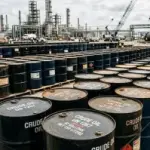
The oil-rich Gulf states have been paralyzed by Iran's attacks on the region's energy infrastructure; Saudi Arabia has stopped operations at its Ras Tanura oil refinery, while Qatar has announced a halt to its largest plant for producing liquid natural gas.
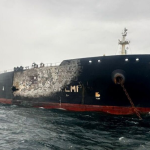
After Iran closed the Strait of Hormuz, a global chokepoint for hydrocarbons, and struck multiple ships attempting to cross, the price of energy increased even more.
Brig. Gen. Ebrahim Jabbari, a paramilitary Revolutionary Guards aide, declared, "The strait of Hormuz is closed," threatening to attack any ships attempting to pass through. "Avoid visiting this area."
Israel hinted at the possibility of a protracted campaign against Hezbollah in Lebanon. Similar to the conflict in Lebanon eighteen months prior, Israel gradually evacuated the southern part of the country by issuing evacuation orders before deploying Israeli troops to occupy the districts near the border.
But given that Israel had drastically reduced Hezbollah's capabilities over the course of two years of daily airstrikes, it was uncertain what kind of resistance the group could provide this time. Israel has declared over the past two days that Hezbollah's intelligence commander, Hussein Makled, and other senior group officers have been killed.
The Hezbollah-run bank al-Qard al-Hassan, members of its political bureau, and a building housing its television outlet al-Manar were among the logistical components of the Lebanese armed group that it targeted on Tuesday morning. Attacks on non-military targets are prohibited, according to rights organizations, even if the targets are members of the group.
Israeli airstrikes in Lebanon have resulted in at least 29,000 displaced individuals and 52 fatalities thus far.
Hezbollah has persisted in its attacks on Israel, claiming to have launched rockets at a facility in the Golan Heights and used one-way drones to strike the Ramat David and Meron airbases in northern Israel.
Hezbollah has faced criticism at home for violating the government's declared neutrality by dragging Lebanon into a conflict with Israel. Lebanon's government banned Hezbollah's military and security operations on Monday, an unprecedented move. The judiciary was ordered by the government to detain those who were shooting rockets against Israel.
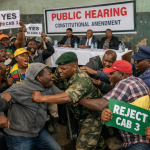
ZANU‑PF is pushing a controversial constitutional amendment in Zimbabwe to extend presidential powers and weaken direct voting rights. Public hearings have been marred by violence, intimidation, and bussing of supporters, raising fears of democratic backsliding.
Long-time ruler, Denis Sassou Nguesso of the Republic of Congo is expected to remain in power with his opponents hindered by voter apathy and what rights organisations characterise as a climate of repression.
Iranian state media is reporting Ayatollah Ali Khamenei has died in U.S.-Israeli strikes on the country.It comes after U.S. President Donald Trump announced his death on Truth Social earlier this evening.