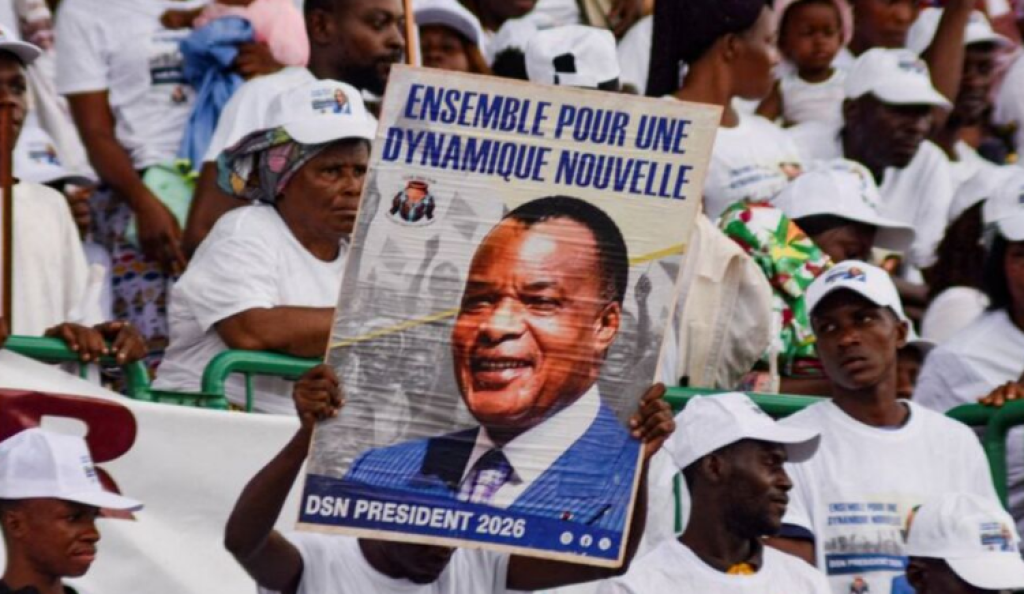
Sunday's presidential election in the Republic of Congo is anticipated to maintain long-time ruler Denis Sassou Nguesso in office, with his opponents hindered by voter apathy and what rights organisations characterise as a climate of repression.
Since 1979, Sassou, 82, has ruled the oil-producing country in Central Africa for all but five of those years. Since the major opposition parties chose not to nominate candidates, he is up against six unknown opponents.
General Jean-Marie Michel Mokoko and André Okombi Salissa, two of the most prominent opposition figures, have been imprisoned for almost ten years after being found guilty of damaging national security.
On March 15, 2026, Congolese voters will cast ballots to choose their president; a divided opposition is unable to field a single candidate. Since the end of the civil war in 1997, the Congolese Labour Party (PCT) and its supporters have dominated the governmental machinery and electoral bodies. The credibility of the vote still depends on citizen involvement, especially among young people who want to see change.
Concerns over opposition access to public media, the accuracy of the electoral register, and the neutrality of the Independent National Electoral Commission further undermine the legitimacy of the electoral process. Etanislas Ngodi has researched party dynamics and political systems in Congo-Brazzaville. He outlines the issues surrounding the presidential election.
Pre-election anxiety is largely caused by what rights organisations characterise as a crackdown on dissent.
According to human rights campaigner Joe Washington Ebina, there have been arrests of activists, suspensions of various opposition parties, and surveillance of public events.
The state's recent deadly crackdown on young gangs, referred to locally as "bébés noirs," he continued, had increased tensions and "created a climate where people no longer feel safe leaving their homes and expressing themselves."
A well-organised and organised majority, a disorganised and weaker opposition, and a contracting civic space characterise this presidential race.
Conditions aimed at maintaining power have been established by the Congolese Labour Party and its allies. This is specifically accomplished by controlling the state machinery, which includes the courts, security services, and electoral umpires.
In order to ensure a wide victory in the first round, Denis Sassou Nguesso, the candidate of the ruling party, who was initially elected to office after the end of the civil war in 1997, also depends on the formation of clientelist networks that reach across almost all social strata.
On the other hand, the Congolese opposition is in disarray as the election draws near. It hasn't been able to agree on a single candidate. The likelihood of democratic reform in the nation is significantly diminished as a result.
Officially, there are six opposition candidates from smaller political groups. They are Destin Melaine Gavet Elengo, Dave Uphreim Mafoula, Joseph Kignoumbi Kia Mboungou, Nganguia Engambe-Anguios, Vivien Romain Manangou, and Mabio Mavoungou Zinga.
Over the past 10 years, a few historical opposition personalities have also left their influence on the political landscape. Among them are Claudine Munari, Cléo Miérassa, and Mathias Dzon. They were also unable to put together a strong coalition that could successfully oppose the ruling party.
A boycott was demanded by the parliamentary opposition, which included the Union of Democrats and Humanists-Yuki (UDH-YUKI) and the Panafrican Union for Social Democracy (UPADS). They brought attention to issues with electoral governance, including the intended use of biometrics, the accuracy of the voter registry, and the objectivity of election administration organisations.
The electoral atmosphere was obviously impacted by pre-election operations, including as security crackdowns, intimidation, and political pressure from authorities.
Although more than 3.2 million Congolese are eligible to vote, many claim they won't since they don't anticipate any suspense.
Boudibangoyi Brunel, a student in Brazzaville, stated, "I would rather stay at home than go and vote."
Although the official turnout for the 2021 presidential election was close to 68%, civil society organisations believe it will now be lower.The real rate of abstinence will be extremely high. "Congolese people are exhausted," Ebina remarked.
(Clement Bonnerot wrote; Robbie Corey-Boulet and Andrei Khalip edited; Bonnerot reported from Dakar and the Congo Republic newsroom.)
According to Afrobarometer polls (rounds 9 and 10) carried out in the nation in 2023 and 2024, 41.6% of participants stated they did not cast a ballot for a variety of reasons. Among these was not having a voter registration (13.1%).
Lack of time (4.3%), apathy toward voting and lack of interest in politics (12.1%), and the lack of local candidates or political parties (4.7%) were other causes. A lack of trust in the electoral process, especially in the election management organisations, was mentioned by a few respondents.
Voter turnout continues to be a key determinant of legitimacy and credibility, as demonstrated by previous elections in the Congo. The turnout rate, which indicates the validity of the election and the winner, is still one of the election's issues.
Discussions over the nation's electoral process typically center on the disparity between the official numbers released by the Ministry of the Interior and firsthand reports from opposition supporters and civil society organisations. They also emphasise the effects of disengaged citizens.
The political balance at the end of this election is unlikely to be altered by the level of turnout, though.
The lack of a serious rival could lead the opposition to claim that the election is illegitimate. Their boycott tactic may result in poor voting participation and strengthen the apathy of young and/or new voters who wish to alter the political class.
A major issue that influences both the result and its acceptability is the election's credibility. Even within the losing parties, issues with fairness, inclusivity, and openness will spark disagreement.