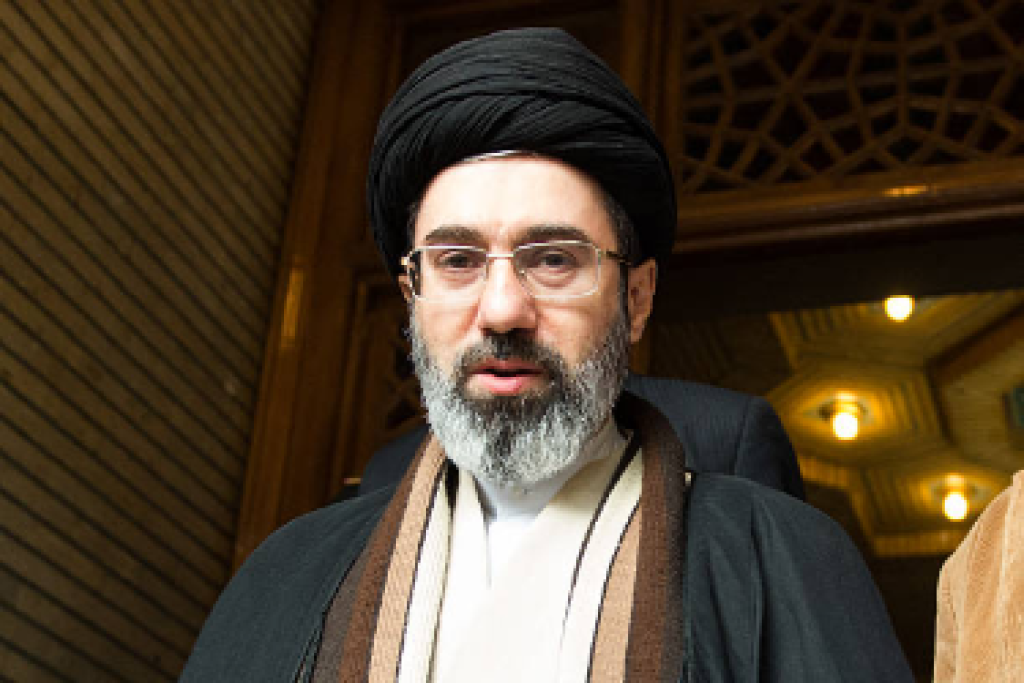
The Assembly of Experts designated the 56-year-old as his father's successor on Sunday and tasked him with guiding Iran through its worst crisis in 47 years.
The military, influential political elites, and the formidable Islamic Revolutionary Guard Corps (IRGC) were prepared to back the new leader.
Masoud Pezeshkian, the president of Iran, declared the appointment to usher in a "new era of dignity and strength" for the nation. The leader declared, "This important decision is an expression of the Islamic nation's desire to strengthen national unity; a unity that, like a solid barrier, has made the Iranian nation resistant to the conspiracies of the enemies."
The Assembly of Experts, a group of 88 clerics entrusted with selecting Ali Khamenei's successor, had seen Mojtaba, a cleric with clout in Iran's security services and extensive economic networks under his father, as a front-runner in the run-up to Sunday's vote.
Just after midnight Tehran time, the Assembly of Experts declared that Ayatollah Seyyed Mojtaba Hosseini Khamenei had been nominated as the third head of the holy system of the Islamic Republic of Iran by a decisive vote.
Mojtaba has the last word on all affairs of state in the Islamic republic thanks to this role.
US President Donald Trump, who stated on Sunday that Washington should have a say in the pick, is sure to be upset at Mojtaba's appointment. "He won't last long if we don't approve."
Israel had vowed to attack the chosen person before the announcement. More than a week ago, one of the initial strikes against Iran claimed the life of Ali, Mojtaba's father. In response to Iran's attacks on US installations in the region, Washington issued an order on Sunday for non-emergency staff at its embassy in Saudi Arabia to leave. This is the most recent withdrawal of US diplomats.
A day after Trump oversaw the return of the remains of the six other Americans slain, the US military announced that a seventh American had died from injuries received during Iran's initial counterattack one week prior.
Iran's envoy claims that thousands of Iranian people have been injured and at least 1,332 have died as a result of the US-Israeli attacks.
The oil trade has been negatively impacted by the worsening conflict, and the rising prices caused share futures in Asia to decline on Monday due to concerns about growing living expenses. In relation to the yen and the euro, the dollar increased dramatically.
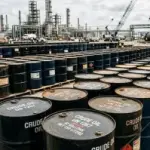
Fearing tighter supply and protracted disruptions to oil shipments via the Strait of Hormuz, US crude futures increased more than 20% in early trading on Monday, reaching their highest level since July 2022. After rising 28% last week, Brent increased 17% to $108.73 (R1,826) per barrel.
Nasdaq futures fell 1.7% and S&P 500 futures fell 1.6% on Wall Street.
In a social media post, Trump claimed that the price increase was "a very small price to pay for US and world safety and peace" and that oil prices "will drop rapidly when the destruction of the Iran nuclear threat is over."
The Islamic Revolutionary Guard declared that they are prepared to submit to the new supreme leader, and Iranian state media reported that the armed forces' leadership had sworn loyalty to Mojtaba Khamenei.
Iran's security director, Ali Larijani, stated on state television following the announcement that the Assembly of Experts convened on Sunday to choose a new supreme leader despite fears that the body will be targeted.
Larijani called for unity around the next leader and stated that Mojtaba Khamenei could lead the nation in the delicate current circumstances.
Under the younger Khamenei, a trained cleric allied to the Revolutionary Guards, the ideological wing of the Islamic Republic's armed forces, few anticipate significant improvements.
The Guards swiftly declared their support for the new leader, who has significantly less experience than his father, who served as president under revolutionary Ayatollah Ruhollah Khomenei, the first supreme leader.
In a statement, the Revolutionary Guards Corps declared itself "ready for complete obedience and self-sacrifice in carrying out the divine commands" of the younger Khamenei.
The head of the Supreme National Security Council, Ali Larijani, who was seen as a crucial power broker under the deceased Khamenei, praised the fact that the leader was "elected with a legal process" in spite of the threats of violence.
Following the overthrow of the pro-Western shah in 1979, the Islamic Republic was established in opposition to hereditary monarchy.
Any new supreme leader would be illegitimate, according to Reza Pahlavi, the late Shah's son who is currently living in exile in the United States and has offered himself as a transitional leader.