U.S.-born Pope Leo XIV pushed back Monday on President Donald Trump’s broadside against him over the U.S.-Israel war in Iran, telling reporters that the Vatican’s appeals for peace and reconciliation are rooted in the Gospel, and that he doesn’t fear the Trump administration.
Pope Leo XIV, who was born in the United States, responded to President Donald Trump's generalizations about the U.S.-Israel conflict in Iran on Monday by telling reporters that the Vatican's calls for peace and reconciliation are grounded in the Gospel and that he has no fear of the Trump administration.
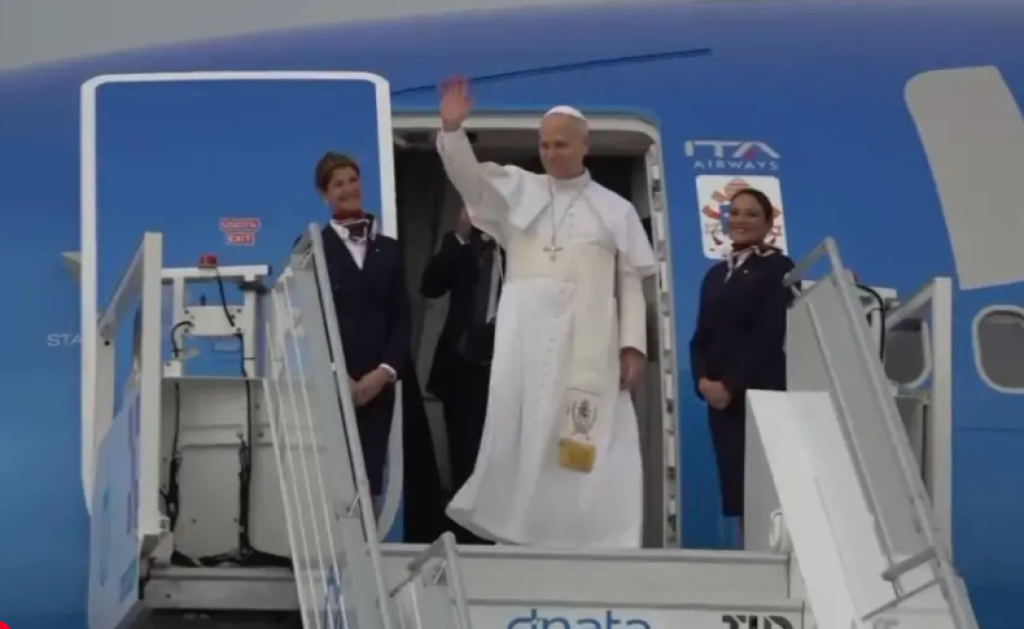
On the papal jet traveling to Algeria, he said, "To put my message on the same plane as what the president has attempted to do here, I think, is not understanding what the message of the Gospel is." “And I'm sorry to hear that, but I will keep doing what I think is the church's current mission in the world.”
The only American-born pope in history emphasized that his universal call for peace and condemnation of the "delusion of omnipotence" that is fuelling the Iran War and other conflicts across the world are not directed at Trump or anybody else.
"I'm not going to argue. I definitely don't aim to offend anyone with what I say. "Blessed are the peacemakers" is the gospel's very obvious message, according to Leo.
"I will not hesitate to proclaim the gospel and encourage everyone to seek ways to prevent war whenever it is feasible, as well as to build bridges of peace and reconciliation."
"I'm not afraid of the Trump administration or of speaking out loud about the message of the Gospel, which is what the Church works for," he continued, addressing other reporters.
Leo is not "doing a very good job," according to Trump
On Sunday night, Trump issued an unusual tirade against Leo, claiming that the global leader of the Catholic Church, who was born in the United States, is "doing a very good job" and that "he's a very liberal person." He also suggested that the pope "stop catering to the Radical Left."
Trump harshly criticized Leo in a long social media post while returning to Washington from Florida, and he continued to do so in remarks to reporters on the tarmac after disembarking.
He declared, "I don't like Pope Leo."
Trump's remarks followed Leo's suggestion over the weekend that the U.S.-Israel battle in Iran is being fueled by a "delusion of omnipotence." While it's not unusual for popes and presidents to have conflicting agendas, it's extremely exceptional for the pope to openly criticize a U.S. leader, and Trump's scathing response is just as rare, if not more so.
The Trump stated in his post, "I don't want a Pope who thinks it's OK for Iran to have a nuclear weapon. Pope Leo is WEAK on Crime, and terrible for Foreign Policy."
Various Italian lawmakers expressed their support for Leo. While Elly Schlein, the leader of the main opposition party, was more forthright and described Trump's accusations as "extremely serious," Premier Giorgia Meloni offered a message of support for his peace mission.
"We don't like a pope who says it's OK to have a nuclear weapon," Trump reiterated in remarks to reporters.
Subsequently, Trump shared a photo that implied he has saintly abilities similar to those of Jesus Christ. A soldier, a nurse, a woman in prayer, and a bearded man wearing a baseball cap watch with admiration as Trump, dressed in a biblical-style garment, places his hands on a bedridden man while light emanates from his fingertips.
Giorgia Meloni, the prime minister of Italy, called Donald Trump's comments against Pope Leo XIV "unacceptable".
The US president told reporters he was "not a big fan" after accusing the pope of being "WEAK on Crime and terrible for Foreign Policy" in a lengthy Truth Social post.As the head of the Catholic Church, the Pope should advocate for peace and denounce all forms of war, Meloni said in a statement.
Meloni, a Catholic leader of a right-wing coalition government and a close Trump ally, has been hesitant to denounce the US president's severe criticism of Pope Leo thus far.
Meloni has come under fire from opposing parties in Italy for his tardiness.
Matteo Salvini, the leader of the populist League party and her coalition partner, stated that "attacking the Pope... doesn't seem like a useful or intelligent thing to do."
Following Trump's comments, the Pope told reporters traveling to Algeria that he will continue to advocate for peace rather than engage in a debate with Trump.
Following the US president's rare and harsh criticism of his position on the Iran conflict, Pope Leo declared that he has "no fear" of the Trump administration and will keep speaking out against war.
He has been an outspoken opponent of the Iran War, calling Trump's vow to destroy Iranian civilization "unacceptable" and urging him to find a "off-ramp" to put an end to the battle.
Trump intensified his assault on Monday, stating that he would not offer an apology to the "very weak" Pope.
Generally speaking, a pope rarely responds directly to remarks made by international leaders.
In the US, there are around 70 million Catholics, or roughly 20% of the total population. Among them is JD Vance, Trump's vice president.
Trump's remarks coincided with the pope's 11-day tour to Africa, his second significant overseas trip since winning the presidency last year.
In Sunday's post, the US president said that the Pope "should get his act together" and that he was "weak on nuclear weapons." This appears to be a reference to Tehran's efforts to develop nuclear weapons, which are one of the reasons why the US and Israel are at war with Iran.
The pontiff was chosen "because he was American, and they thought that would be the best way to deal with President Donald J. Trump," he added.Leo wouldn't be in the Vatican if I weren't president."
When reporters questioned him about the appointment, he responded, "I don't think he's doing a very good job; he likes crime, I guess."
Trump also stated: "He's a very liberal person, and he's a man who doesn't believe in stopping crime, he's a man who doesn't believe we should be toying with a country that wants a nuclear weapon so they can blow up the world."
In response, the Pope told reporters aboard his flight to Algiers that he saw his role as one of promoting peace rather than that of a politician. He told reporters, "I have no fear of the Trump administration or speaking out loud about the gospel, which is what I believe I am here to do, what the Church is here to do."
"I don't want to get into a debate with [Trump]," he said. There are far too many suffering people in the world today. There are far too many innocent deaths. And I believe that someone needs to speak up and say, "There's a better way to do this."
"Not even Hitler or Mussolini attacked the Pope so directly and publicly," noted Massimo Faggioli, a well-known Catholic commentator from Italy.
The Pope has called for de-escalation in the Middle East and condemned world wars in multiple public speeches.
He said that Trump's threat that "a whole civilization will die tonight" was "truly unacceptable" in response.
Trump's strict immigration policies have also drawn criticism from the Pope, who questioned whether it was possible for someone to be “pro-life. ”a term typically associated with opponents of abortion, if they supported what he called the “inhuman treatment of immigrants.”
Pope Leo is perceived as carrying on the humanitarian legacy of his predecessor, Pope Francis, who declared Trump to be "not Christian" due to his anti-immigrant remarks during the 2016 presidential campaign. The late Pope was called "disgraceful" by Trump.
The head of the U.S. Conference of Catholic Bishops, Archbishop Paul S. Coakley, said in a statement that Trump's remarks "disheartened" him.
"The Pope is not a politician, nor is Pope Leo his adversary. According to Coakley, "He is the Vicar of Christ who speaks from the truth of the Gospel and for the care of souls."
The pope "is not a political counterpart, but the successor of Peter, called to serve the Gospel, truth, and peace," according to the Italian Bishops' Conference, which also voiced sadness over Trump's remarks.
ZANU‑PF is pushing a controversial constitutional amendment in Zimbabwe to extend presidential powers and weaken direct voting rights. Public hearings have been marred by violence, intimidation, and bussing of supporters, raising fears of democratic backsliding.
Iran confirms the death of security head Larijani, with the Supreme National Security Council announcing that Ali Larijani was killed in an Israeli airstrike alongside his son Morteza Larijani, the head of his office Alireza Bayat, and several guards.
Iran has named Mojtaba Khamenei as its new supreme leader, roughly a week after his father, Ayatollah Ali Khamenei, was assassinated in a combined US-Israeli operation that sparked a regional crisis