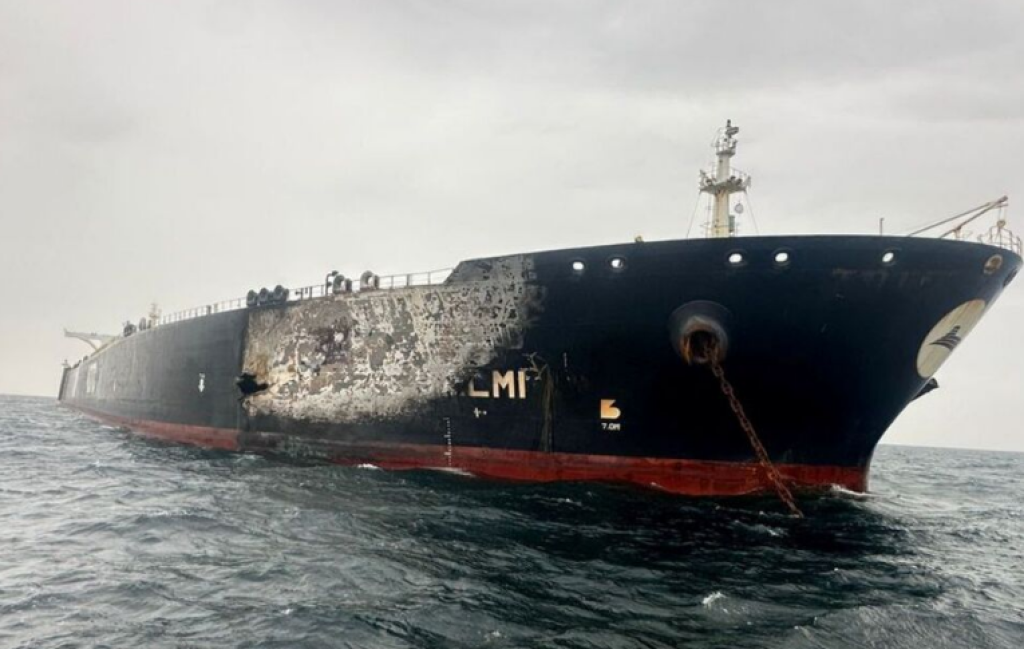
Despite President Donald Trump's threat that the United States will destroy Iran's energy facilities if it does not reach a peace agreement and open the Strait of Hormuz, Tehran attacked and set fire to a fully laden crude oil tanker off Dubai on Tuesday.
Following a drone strike, the fire on the Kuwait-flagged Al-Salmi was contained, according to Dubai authorities, and there was no oil loss or crew injuries. The ship's owner, Kuwait Petroleum Corp., reported that the hull was damaged.
Since the US and Israel assaulted Iran on February 28, this was the most recent strike on commercial ships in the strait, an important waterway.
According to tracking service TankerTrackers.com, LSEG Data revealed that the ship was carrying 800,000 barrels of Kuwaiti crude and 1.2 million barrels of Saudi crude oil on its way to Qingdao, China. Al-Salmi might not have been the original target. Iran's Revolutionary Guard claimed to have attacked a container ship in the Gulf because of its connections to Israel. However, shipping data suggested that they were talking to the Singapore-flagged Haiphong Express, which was anchored adjacent to the Al-Salmi.
According to Kuwait Petroleum Corporation (KPC), the Al Salmi was attacked by Iran when it was anchored at Dubai Port in the United Arab Emirates. The incident resulted in an onboard fire and other damage to the ship.
The drone strike caused the fire, which was successfully put out by maritime firefighting services, according to Dubai authorities, who also stated that all 24 crew members were safe and that no casualties were reported.
After the attack on the tanker, which can carry about 2 million barrels of oil worth more than $200 million at current prices, was reported by Kuwait's state news agency, crude oil prices briefly surged. However, they slightly decreased after the Wall Street Journal revealed that Donald Trump had told aides he was willing to end the war even if the strait of Hormuz remains closed and that military options were "not his immediate priority."
The Middle East conflict is expected to cause Brent crude prices to rise by 59% in March, the biggest monthly increase ever.
In addition to being a political headache for Trump and his Republican party ahead of the November midterm elections, the increase in oil and fuel costs has begun to put a strain on US household finances. Trump has promised to cut energy prices and increase US oil and gas production.
Industry trackers report that the tanker was laden with two million barrels of oil from Saudi Arabia and Kuwait. Reports state that Qingdao, China, was mentioned as its destination.
Fears of a bigger confrontation are mounting as attacks by both sides of the conflict show no signs of abating.
As part of a reinforcement that would increase Trump's options to include the deployment of forces inside Iranian territory as he pursues negotiations with Tehran, thousands of soldiers from the US army's elite 82nd Airborne Division have begun to arrive in the Middle East.
After extending an earlier deadline he had set for Iran to open the strait of Hormuz, the narrow waterway that typically carries about a fifth of the world's oil and liquefied natural gas supplies, White House press secretary Karoline Leavitt stated that Trump wanted to reach an agreement with Tehran before the 6 April deadline he set last week.
Following those remarks, Trump delivered a fresh warning regarding the Strait of Hormuz while stating that the United States was in negotiations with a “more reasonable regime,” a reference to the Iranian officials who had taken the place of those dead in the conflict.
In addition to being a political headache for Trump and his Republican Party ahead of the November midterm elections, rising oil and fuel costs have begun to have an impact on American households' pocketbooks.
Iran-aligned Houthis in Yemen joined the conflict by firing into Israel, while Turkey said on Monday that a ballistic missile fired from Iran had infiltrated Turkish airspace before being shot down, further escalating the conflict.
The battle has also rekindled hostilities between Israel and Hezbollah, a Lebanese organization supported by Iran. Iran, which has suffered the greatest number of casualties in the conflict, has opened fire on targets in Gulf Arab nations where the United States maintains military installations.
Iran's military spokesperson claimed that "hideouts" of American military troops in five bases in the region and in Israel were among the targets of the country's most recent attacks.
After a drone was intercepted in Kharj province on Tuesday, blasts reverberated throughout Dubai. According to Saudi Arabia's civil defense, falling debris caused minimal damage.
According to Iran's Tasnim news agency, people in the eastern Pirouzi area reported power disruptions and heard explosions in Tehran.
Three persons were killed in an attack on a Shi'ite Muslim assembly hall in the Iranian city of Zanjan in the northwest, according to a provincial official who spoke to Iranian media.
Three Indonesian UN troops were killed in two different events in southern Lebanon, according to Israel's military, which also said that four of its soldiers had been slain.