Trump announces major combat operations in Iran, vowing to destroy missiles, prevent nuclear weapons, and urge Iranians to seize freedom.
Politics
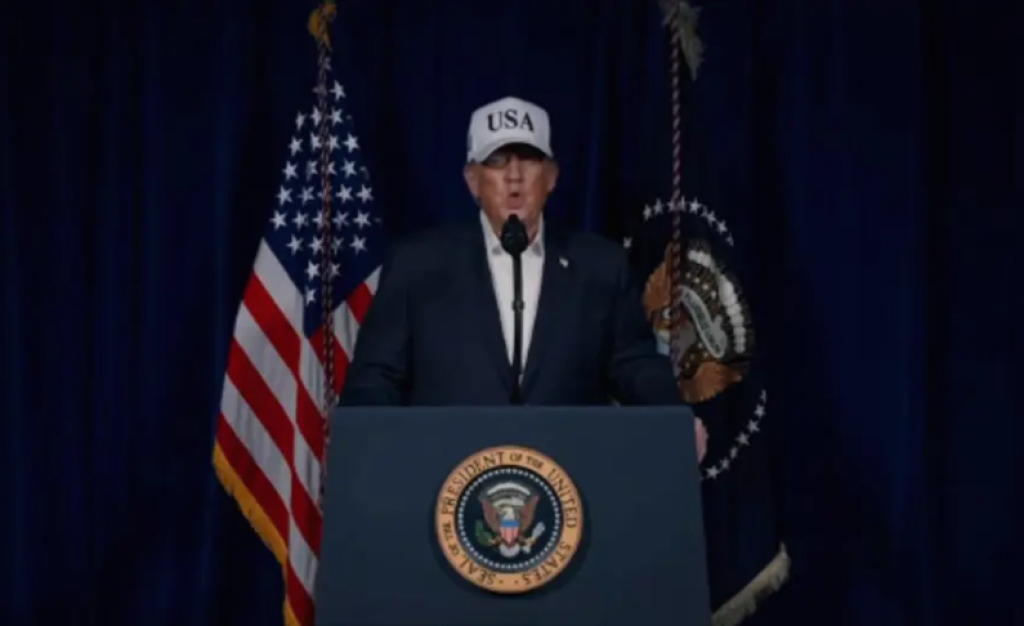
In a nationally televised address, President Donald Trump announced that the United States military has begun major combat operations in Iran, citing imminent threats from the Iranian regime. His speech, delivered with dramatic urgency, framed the campaign as both a defensive mission to protect Americans and a broader effort to reshape the Middle East.
Trump’s speech leaned heavily on a narrative of decades‑long hostility:
1979 Embassy Takeover: Hostages held for 444 days in Tehran.
1983 Beirut Barracks Bombing: 241 U.S. service members killed.
2000 USS Cole Attack: Alleged Iranian involvement.
Iraq War Casualties: Hundreds of Americans killed or maimed by Iranian proxies.
By invoking these events, Trump positioned Iran as a persistent aggressor and “the world’s number one state sponsor of terror.”
Operation Midnight Hammer
Trump highlighted Operation Midnight Hammer, a June strike that he claimed obliterated Iran’s nuclear facilities at Fordo, Natanz, and Isfahan. He insisted that Iran “will never have a nuclear weapon,” repeating the phrase for emphasis.
This section of the speech underscored his administration’s red line: preventing Iran from acquiring nuclear capability, regardless of diplomatic setbacks.
Military Objectives Outlined
Trump laid out sweeping goals for the campaign:
Destroy Iran’s missiles and missile industry
Annihilate Iran’s navy
Neutralize terrorist proxies across Lebanon, Yemen, Syria, and Iraq
Prevent Iran from rebuilding its nuclear program
The language was uncompromising: “obliterated,” “annihilate,” “destroy.” It conveyed both confidence in U.S. military strength and a warning to Iran’s leadership.
Appeal to Iranian Forces and Citizens
Trump issued a stark ultimatum to Iran’s Revolutionary Guard and police:
Lay down arms for immunity
Or face certain death
To ordinary Iranians, he promised liberation: “The hour of your freedom is at hand.” He urged them to stay sheltered during bombing, then seize control of their government once the campaign ended.
This rhetoric blended military strategy with regime‑change messaging, portraying the U.S. as a liberator rather than an occupier.
Religious and Patriotic Tone
The speech was infused with religious appeals:
Prayers for U.S. service members.
Trust in God’s protection.
Framing the mission as noble and future‑oriented.
Trump emphasized his role in rebuilding the military during his first administration, declaring it “the greatest in the world.”
Implications for U.S. Foreign Policy
The announcement signals a dramatic escalation in U.S.–Iran tensions. Key implications include:
Regional destabilization: Risk of proxy conflicts spreading further.
Global reactions: Allies in Europe and the Middle East may face new security challenges.
Nuclear non‑proliferation precedent: Reinforces U.S. willingness to use force to prevent nuclear development.
The speech also raises questions about long‑term strategy: Is this a limited strike campaign, or the beginning of a broader effort to topple Iran’s regime?
Comparison: Trump’s Objectives vs. Iran’s Position
Issue
Trump’s Position
Iran’s Position (as perceived)
Nuclear Weapons
Never permitted
Continued pursuit despite strikes
Terrorist Proxies
Must be neutralized
Support across Lebanon, Yemen, Syria, Iraq
Revolutionary Guard
Lay down arms or die
Loyal to regime
Iranian Citizens
Encouraged to seize freedom
Historically suppressed dissent
U.S. Military Role
Overwhelming force, liberation
Viewed as foreign aggression
Trump’s speech announcing combat operations in Iran marks a turning point in U.S. foreign policy. By invoking decades of grievances, highlighting Operation Midnight Hammer, and pledging to annihilate Iran’s military infrastructure, he framed the campaign as both defensive and liberating.
The stakes are enormous: preventing nuclear proliferation, reshaping regional power dynamics, and testing whether regime‑change rhetoric can translate into lasting stability. For now, the world watches as the U.S. military undertakes one of its most ambitious operations in recent history.
U.S.-born Pope Leo XIV pushed back Monday on President Donald Trump’s broadside against him over the U.S.-Israel war in Iran, telling reporters that the Vatican’s appeals for peace and reconciliation are rooted in the Gospel, and that he doesn’t fear the Trump administration.
ZANU‑PF is pushing a controversial constitutional amendment in Zimbabwe to extend presidential powers and weaken direct voting rights. Public hearings have been marred by violence, intimidation, and bussing of supporters, raising fears of democratic backsliding.
Iran confirms the death of security head Larijani, with the Supreme National Security Council announcing that Ali Larijani was killed in an Israeli airstrike alongside his son Morteza Larijani, the head of his office Alireza Bayat, and several guards.